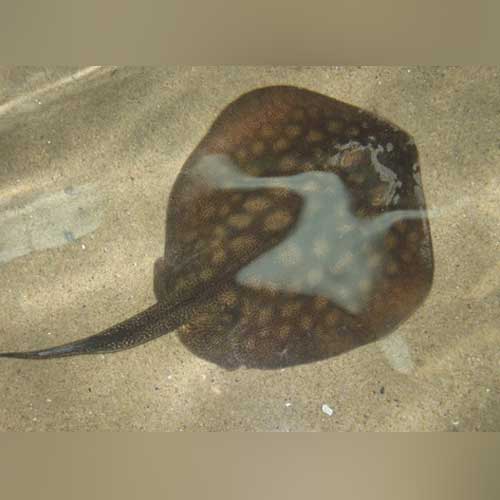
California Stingray
California Stingray
The California Stingray, or Haller's Round Ray, is a species of round ray, family Urotrygonidae, found in the coastal waters of the eastern Pacific Ocean. It is a small, common ray that feeds mostly on benthic invertebrates. On the beaches of southern California.
In nature, round stingrays strongly segregate by age and sex, with the females staying in water deeper than 14 m and males and juveniles in shallower habitat. The juveniles feed on polychaete worms and small benthic crabs until they are 14 cm across. As they mature, their diet shifts towards bivalve mollusc. Round stingrays are daytime foragers that are most active in the warm temperatures of summer and fall. Using their pectoral disc and mouths, they dig large pits to uncover buried prey. The digging of these pits plays an ecologically important role, as they also uncover prey for smaller fish.
- Scientific name: Urobatis halleri
- Origin: California
- Max size: 10 inches
- Diet: Ghost shrimp, meaty pieces like squid
- Shipping Size: Small 3 to 5 inches Medium 5 to 6 inches Large 7 to 10 inches
Original: $385.49
-65%$385.49
$134.92Product Information
Product Information
Shipping & Returns
Shipping & Returns
Description
California Stingray
The California Stingray, or Haller's Round Ray, is a species of round ray, family Urotrygonidae, found in the coastal waters of the eastern Pacific Ocean. It is a small, common ray that feeds mostly on benthic invertebrates. On the beaches of southern California.
In nature, round stingrays strongly segregate by age and sex, with the females staying in water deeper than 14 m and males and juveniles in shallower habitat. The juveniles feed on polychaete worms and small benthic crabs until they are 14 cm across. As they mature, their diet shifts towards bivalve mollusc. Round stingrays are daytime foragers that are most active in the warm temperatures of summer and fall. Using their pectoral disc and mouths, they dig large pits to uncover buried prey. The digging of these pits plays an ecologically important role, as they also uncover prey for smaller fish.
- Scientific name: Urobatis halleri
- Origin: California
- Max size: 10 inches
- Diet: Ghost shrimp, meaty pieces like squid
- Shipping Size: Small 3 to 5 inches Medium 5 to 6 inches Large 7 to 10 inches